
Leadership On Demand Membership Is Officially Open
You weren't built to carry it all alone.
On Sunday, October 4, during our Faith Talk, we officially opened the doors to Leadership On Demand membership. If you were with us live, you felt it. Something shifted in the room.
For years, this community has been a place where leaders come to think, pray, learn and grow together. More than 5,000 of you have joined that conversation. Now there's a deeper way in: a membership built for leaders who are ready to stop carrying everything by themselves.
Why I Built It
The decisions. The team. The vision. It's heavy, and it's lonely at the top.
I've led large operations. I've built teams from a handful of people into hundreds. And I've learned that most leaders don't have a capability problem. They have a decision problem. Every choice routes back to their desk, meetings end without an owner, and the vision stalls while they carry it alone.
Your team is capable. Your decision system may not be. Leadership On Demand exists to fix that, with practical tools, real conversation and people who will hold you to what you said you'd do.
What's Inside
Membership is built around four things that keep you moving week to week:
- A weekly leadership brief. One focused read with an action guide, so you leave with a next step, not just an idea.
- Two monthly live Leadership Labs. Real-time teaching and Q&A where we work through the decisions you're facing right now.
- Peer accountability that actually holds you accountable. A community of leaders who will ask what you did, not just what you planned.
- A vault of my go-to decision templates. The same frameworks I use to clarify ownership, move faster and stop decisions from bottlenecking.
The First Leadership Lab is Thursday, October 15 at 7 p.m.
Our first live Leadership Lab kicks off Thursday, October 15 at 7 p.m. Bring a real decision you're wrestling with. We'll work through it together, out loud, with leaders who understand the weight.
Join before then and you'll be in the room from day one.
Who It's For
Leadership On Demand is a private community for founders, executives and emerging leaders who are ready to decide clearly, execute boldly and build beyond themselves.
It's for you if every decision seems to wait on you, if your vision is bigger than your current capacity, or if you simply want to lead where faith, business and leadership align. You don't need a big title. You need to be ready to grow.
Launch Pricing: $17 a month
To celebrate the launch, membership is $17 a month for your first 3 months. After that, it's $29.97 a month, and you can cancel anytime.
That's less than the cost of one more decision made alone.
For Leaders Who Want More: The VIP Inner Circle
Some rooms open by request. The VIP Inner Circle is limited to 25 members, on purpose. Keeping it small protects the closeness, candor and real participation this level of work requires.
VIP members get direct access to me, along with strategy sessions, hot-seat coaching and curated introductions. The full picture stays behind closed doors until you ask, so if you're ready for that level, request the VIP room at lod.life.
Tap In
You weren't built to carry it all alone, and you don't have to. Join 5,000+ leaders who are deciding clearly, executing boldly and building beyond themselves.
Claim your $17 launch rate at lod.life and I'll see you at the first Leadership Lab on October 15.
T.M. Hyman, The Decision Architect
Why Is This On My Desk? Is Officially Available Today
T.M. Hyman reveals why capable teams wait and critical decisions keep returning to one leader.
Today marks the official release of Why Is This On My Desk? How Leaders Stop Being the Bottleneck, Fix Broken Delegation, and Give Every Decision a Single Owner.
I wrote this book for the leader who has built a capable team but still carries too many decisions.
The work may be delegated. Responsibilities may be assigned. Meetings may be happening. Yet approvals, questions, exceptions and unresolved issues continue to return to the same desk.
Yours.
At first, this can feel like a normal part of leadership. You are experienced. You care about the outcome. You know the business. When something becomes unclear, people naturally come to you.
But as the organization grows, that pattern becomes expensive.
Projects slow down while people wait. Meetings revisit questions that should have been settled. Strong employees hesitate because they are unsure where their authority begins and ends. Leaders become overloaded, not because their teams are incapable, but because the organization has never clearly defined how decisions should move.
That is the problem this book was written to solve.
Most Leaders Do Not Have a Delegation Problem
Many leaders believe they need to delegate more. In reality, they have often delegated the work without transferring the authority required to complete it.
The team may own the assignment, but the leader still owns every meaningful trade-off.
The team can gather information, prepare options, and make recommendations.
But when it is time to make the final call, the decision moves back to the top.
That is not complete delegation. It is distributed work with centralized authority.
Over time, the organization learns the real operating rule: when the decision matters, wait for the leader.
The result is a decision bottleneck.
This bottleneck does not always look like control. Sometimes it looks like responsiveness. The leader answers quickly, rescues stalled projects, resolves disagreements and keeps work moving.
But every rescue teaches the organization where unresolved decisions belong.
That is why the question is not simply, “Who should do the work?”
The more important question is, “Who has the authority to make and close the decision?”
Introducing The Decision Advantage™
Why Is This On My Desk? introduces The Decision Advantage™, a practical leadership operating system built around six disciplines:
- Define the real decision. Problems are not decisions. Write the sentence.
- Eliminate cognitive drag. Complexity is in the situation. Drag is in the conversation. Sort the variables.
- Clarify decision filters. Name the criteria, rank them, and make the trade-off visible.
- Install decision ownership. Give one decision to one named owner with a clear boundary.
- Stabilize under pressure. Name the pressure without allowing it to make the decision.
- Execute with momentum. Take the first visible action within forty-eight hours and identify what must stop.
These disciplines are designed to help leaders move beyond telling people to “take more ownership.” They create the structure that makes ownership possible.
Clear ownership does not eliminate accountability. It strengthens it.
When one person owns the decision, the team knows who will close the call. When the boundaries are clear, people understand what they can decide without escalation. When the criteria are visible, disagreements can be resolved around priorities instead of personalities.
That is how decisions begin to move.
This Book Is for Leaders Who Are Ready to Build Beyond Themselves
This book is for founders, entrepreneurs, business owners, executives, managers, and leadership teams who recognize that growth cannot continue to depend on one person carrying every important decision.
It is for the leader who is tired of being the final answer to every question.
It is for the manager whose team is busy but still hesitant.
It is for the organization that has added people, technology, meetings, and processes without gaining the speed or clarity it expected.
It is also for leaders preparing to use artificial intelligence more deeply inside their businesses.
AI can produce information, analysis, options, and recommendations faster than ever. What it cannot do is supply human authority or assign decision ownership. If the decision system is unclear, AI may accelerate the ambiguity instead of resolving it.
Before organizations automate more work, they must determine who owns the decisions that work produces.
Your Team May Not Be the Problem
One of the central ideas in this book is simple:
Your team is capable. Your decision system may not be.
When capable people repeatedly wait, escalate or ask for permission, leaders often assume they lack confidence or initiative.
Sometimes the structure is teaching them to wait.
If authority is unclear, escalation becomes the safest choice. If leaders frequently reverse decisions, employees learn that ownership is temporary. If every important call must survive another round of approval, people stop treating decisions as settled.
The goal is not to assign blame.
The goal is to identify the structure producing the delay.
Once you can see the bottleneck clearly, you can stop compensating for it and begin redesigning how decisions move.
Why This Book Matters Now
Leadership pressure is increasing.
Organizations are managing more complexity, tighter margins, shifting customer expectations, changing workforce dynamics, and rapidly expanding technology. Yet many are still moving decisions through systems designed for smaller teams and slower environments.
Leaders cannot solve that problem by working longer, attending more meetings or personally processing decisions faster.
Deciding faster only makes you a more efficient bottleneck.
Designing how decisions move is how you stop being one.
That is the work of The Decision Advantage™.
Order Your Copy Today
Why Is This On My Desk? is officially available today for $19.99.
With your order, you will also receive the Decision Bottleneck Diagnostic, a practical tool designed to help you identify where decisions are slowing down, returning upward or remaining without a clear owner.
If everything still comes back to you, it is time to stop asking how you can carry more.
Start asking how the decision should move.
Order your copy today at WhyIsThisOnMyDesk.com.
Your team is capable. Now build a decision system that allows them to prove it.
About the Author
T.M. Hyman is a leadership strategist, executive coach, and founder of TM Hyman & Associates, LLC. Known as The Decision Architect, he empowers founders, business owners, and leadership teams to eliminate decision bottlenecks, strengthen execution and build organizations that no longer depend on one person to keep everything moving.
Drawing on more than two decades of experience in organizational performance, sales leadership, and operational transformation, T.M. developed The Decision Advantage™ to help leaders transfer authority, clarify ownership and turn stalled decisions into consistent action.
He is also the founder of Leadership On Demand, a community serving more than 5,000 leaders and The Center for Next Generational Leadership™.

2026 Leadership ON demand summit - faith. finances. future.
What If the One Conversation You Need Happens in a Room You Almost Didn’t Enter?
You can watch the recap.
You can see the photos.
You can hear someone say, “You should have been there.”
You can't recreate the conversation that happened at the table, the introduction made during lunch, the idea that changed someone's business model, or the moment a leader finally saw what had been keeping their vision stuck.
That's why the 2026 Leadership On Demand Summit isn't being built as another conference.
It's being built as the room.
The room where faith and business don't have to compete.
Where conversations about vision can sit beside conversations about money, credit, capital, revenue, AI, ownership and opportunity.
Where you don't have to pretend you have everything figured out before you arrive.
And where the person sitting beside you may be just as important as the person holding the microphone.
Something Different Happens When the Right People Get in the Same Room
September 25–27, leaders, entrepreneurs, founders, creators, executives and visionaries will gather in Atlanta around one central idea:
FAITH. FINANCES. FUTURE.
Here's what makes this different.
You're not coming simply to listen.
You'll be asked to put a number beside your vision.
You'll confront the decisions that keep finding their way back to your desk.
You'll examine whether your audience is actually producing revenue.
You'll see how AI can move from something you experiment with to something you build with.
You'll walk into conversations knowing your ASK and your OFFER.
You'll encounter people who may know someone you need to know.
Somewhere during those three days, you may hear the sentence, meet the person or recognize the opportunity that makes you say:
“That's why I needed to be here.”
Then There's the Part We're Not Going to Spoil
Some moments at the Summit are intentionally designed to unfold only after you're in the room.
Your vision will leave your hands.
You'll get it back later.
What happens between those two moments is part of the experience.
So is what happens when other people are given permission to think about what you're building.
There's a reason December 26 matters before you leave Atlanta.
You'll understand when you're there.
Still Deciding Whether You Should Come?
Ask yourself a different question.
Not:
“Can I afford another event?”
Ask:
“What could it cost me to spend another year trying to build this from the same conversations, same relationships, same resources and same way of thinking?”
Sometimes the next move isn't another course.
It isn't another podcast.
It isn't another saved post you'll never revisit.
Sometimes you need to change the room.
And when you get into the right one, one introduction can change your access.
One conversation can change your strategy.
One decision can give you back months.
One relationship can open a door you couldn't open alone.
One idea can become an entirely new revenue stream.
That's the possibility we're creating in Atlanta.
You Can Hear About It Later. Or You Can Be There When It Happens.
The 2026 Leadership On Demand Summit takes place November 13–15, 2026, in Atlanta, Georgia.
Three days.
One carefully curated community.
Conversations around FAITH. FINANCES. FUTURE. that could influence what you build next.
If something in you keeps saying, “I probably need to be in that room,” don't ignore it.
You may already know.
The question is whether you'll act on it.
See what’s happening at the 2026 Leadership On Demand Summit and claim your seat
FAITH
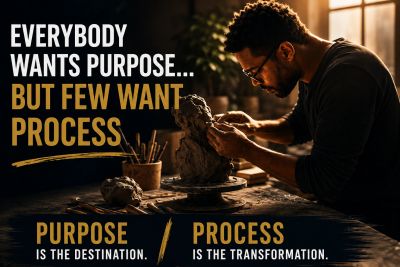
Everybody Wants Purpose… But Few Want Process
Purpose gives you direction. Process develops the person capable of carrying it.
Everybody wants purpose.
We want to know why we're here, what we're called to do, and when the opportunity we've been praying for will finally arrive.
But there's a part of purpose we don't talk about nearly enough:
The process.
Purpose is exciting. Process can be painfully ordinary.
Process is showing up when nobody notices. Remaining consistent when results are slow. Continuing to believe when the door hasn't opened. Doing the work long before anyone calls you successful.
And that's difficult in a culture that has trained us to expect almost everything quickly.
We See the Win. We Rarely See What Built It.
Social media gives us front-row seats to everybody else's breakthrough.
The promotion. The business launch. The new house. The book deal. The platform. The opportunity.
What we don't see are the years before the announcement.
The rejection. The mistakes. The sacrifice. The quiet prayers. The days when quitting would have been easier than continuing.
We call people “overnight successes” because we discovered them overnight.
That doesn't mean they became successful overnight.
Comparison becomes dangerous when we compare someone else's visible harvest with our invisible planting season.
You may not be behind.
You may simply be in process.
What If the Slow Season Is Building You?
Think about a seed.
Once planted, it can appear as though nothing is happening. Above ground, there's no evidence of progress.
Underneath, roots are forming.
Your life can work the same way.
There are seasons when God appears quiet, opportunities move slowly, and progress becomes difficult to measure. Yet those seasons can develop the very things your next level will require: patience, discipline, humility, discernment, resilience and faith.
Joseph received the dream long before he entered the palace. David was anointed long before he became king.
The calling came first.
The capacity came through process.
Sometimes God shows us enough of the destination to keep us moving while using the journey to prepare us for what we've seen.
Imagine Getting Everything You Prayed for Too Soon
What if the opportunity arrived before your character could sustain it?
The money before your discipline.
The influence before your identity was secure.
The growth before you learned how to lead.
The relationship before you healed.
We often ask God to accelerate what wisdom may be trying to strengthen.
Sometimes the delay isn't keeping something from you.
It's developing something in you.
That's why faith during slow seasons matters.
Galatians 6:9 reminds us not to grow weary in doing good because, “at the proper time we will reap a harvest if we do not give up.”
Notice the language: the proper time.
Not our preferred time.
Faith is continuing to plant when you can't yet see the harvest.
You Can't Microwave Maturity
We live in an instant world.
Information in seconds. Same-day delivery. On-demand entertainment. AI-generated answers almost immediately.
But some things still refuse to be rushed.
Trust takes time.
Wisdom takes time.
Character takes time.
Mastery takes time.
Spiritual maturity takes time.
You can accelerate information. You cannot download experience.
Delayed gratification is becoming increasingly rare, and increasingly valuable.
The person willing to learn while others want shortcuts, practice while others want attention, and remain consistent while others chase the next thing develops something impossible to manufacture overnight:
Depth.
Don't Just Ask, “How Much Longer?”
If you're in a slow season, ask a different question:
“Who is this season requiring me to become?”
Are you becoming wiser?
More disciplined?
Less reactive?
More discerning?
Less dependent on validation?
More capable of trusting God without knowing every detail?
Then progress is happening, even if nobody else can see it yet.
Some of your greatest victories will happen privately before anyone celebrates them publicly.
So keep building.
Keep praying.
Keep learning.
Keep showing up.
Keep believing.
Don't become so obsessed with reaching the destination that you miss what the journey is developing within you.
Because perhaps the breakthrough isn't simply receiving what you prayed for.
Perhaps part of the miracle is discovering that you became someone capable of carrying it.
LOD WEEKLY REFLECTION
Before asking, “God, when is it my turn?”
Try asking:
“God, what are You developing in me while I wait?”
Purpose gives you direction.
Process gives you transformation.
And sometimes, becoming is the miracle before the miracle.
Article Architect : T.M. Hyman
BUSINESS

Networking Is Dying. Strategic Relationships Are Replacing It.
The future of business won't belong to the person with the biggest contact list. It will belong to the person people trust enough to call.
At 8:47 p.m., the conference ballroom was nearly empty.
Most attendees had spent the evening exchanging business cards, scanning LinkedIn QR codes and trying to meet as many people as possible.
One executive did something different.
He spent nearly forty minutes talking with the same three people.
No aggressive pitch. No race to work the room.
Just a real conversation.
Six months later, one relationship became a strategic partnership. Another produced a client introduction. The third eventually recommended him for an opportunity he didn't even know existed.
Meanwhile, another attendee left that same conference celebrating more than 70 new contacts.
Most never spoke again.
That's the difference between collecting contacts and building relational capital.
Access Is Everywhere. Trust Isn't.
Technology has made it incredibly easy to reach people.
You can accumulate thousands of LinkedIn connections, followers, email addresses and phone numbers.
But ask yourself something more important:
How many people would put their reputation beside your name?
Because when a CEO needs a consultant, a company needs a speaker, an investor needs expertise or an executive needs a trusted partner, the first question often isn't:
“Who has the biggest following?”
It's:
“Who do you know?”
A referral transfers something a resume can't manufacture instantly: trust.
That's why one strong relationship can sometimes outperform hundreds of casual connections.
Your Network Isn't Necessarily Your Ecosystem
A network is everyone you can reach.
An ecosystem is the group of people with whom value can move.
Imagine a business owner connected to an attorney, banker, technology expert, marketing strategist and other entrepreneurs with complementary expertise.
One opportunity appears.
Suddenly capital, knowledge, relationships, technology and execution can come together around it.
Nobody has to employ everybody.
They simply know how to create value together.
That is where business is heading.
The strategic question is shifting from:
“Who do I know?”
to:
“Who can I build with?”
Stop Withdrawing Before You Deposit
People can feel transactional networking almost immediately.
The friendly message.
The quick compliment.
Then, three sentences later, the ask.
Strategic relationships operate differently.
You make the introduction.
Share the opportunity.
Offer useful insight.
Recommend someone's work.
Remember what matters to them.
Show up when there isn't an immediate transaction attached.
These small deposits create something difficult to automate or imitate:
relational equity.
And when the right opportunity eventually appears, trust doesn't have to be created from scratch.
It's already there.
Proximity Still Matters
Even in an increasingly digital world, some opportunities happen because you were simply in the right room long enough for people to experience you.
Not your elevator pitch.
You.
How you think.
How you listen.
How you treat people.
How you contribute when nothing is being sold.
That's why the hallway conversation, dinner after the conference or unexpected introduction can become more valuable than the formal networking session.
Algorithms create reach.
Proximity creates context.
And context helps create trust.
Try This at Your Next Event
Forget trying to meet everybody.
Look for three people:
Someone you can learn from.
Someone you can help.
Someone you might eventually build with.
Then have a real conversation.
Ask what they're working on.
Understand what they're trying to solve.
Listen for where your worlds genuinely intersect.
You don't need 50 new contacts from every room.
Sometimes you need two relationships worth continuing.
Because networking isn't dying because relationships matter less.
It's changing because shallow relationships aren't enough anymore.
The future belongs to people who build communities of trust, complementary expertise and shared opportunity.
So stop measuring the strength of your network by how many people are in it.
Measure it by something harder:
Who answers your call?
Who mentions your name when you're not in the room?
And who would build something meaningful with you?
That's not networking.
That's relational capital.
Article Architect : T.M. Hyman
LEADERSHIP
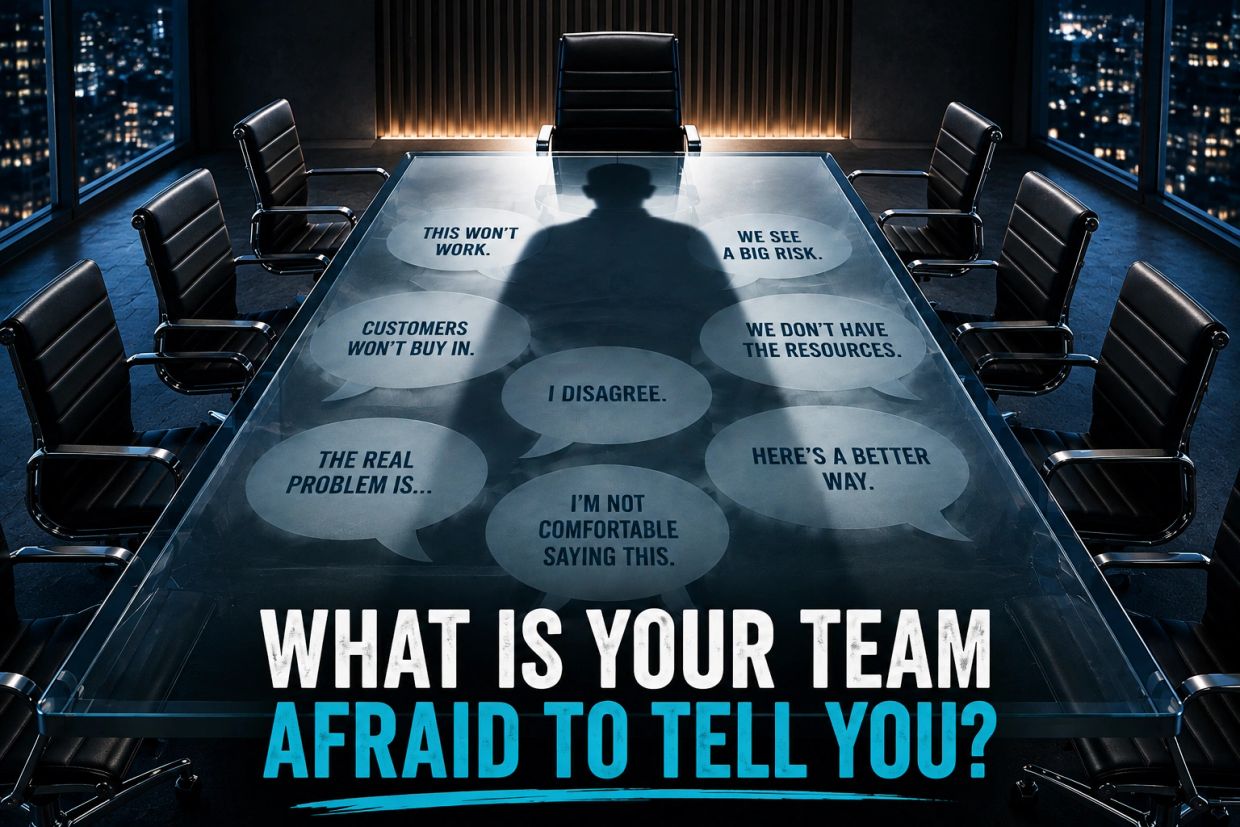
People Don’t Follow Titles AnymorE, They Follow Emotional Safety
Your team may respect your position and still be afraid to tell you the truth.
The meeting ends with a familiar question:
“Everybody good?”
Heads nod. Someone says, “Absolutely.” The leader leaves believing everyone is aligned.
Twenty minutes later, the real conversation starts.
“This timeline isn't realistic.”
“Then why didn't anybody say anything?”
A pause.
“Because you know what happens when somebody pushes back.”
That's not an engagement problem.
That's a leadership problem.
When people learn that disagreement comes with a price, they don't necessarily leave. First, they become careful.
They stop challenging assumptions. They soften bad news. They agree publicly and disagree privately.
Eventually, the leader is making decisions with only a fraction of the team's intelligence.
The Leadership Test
Ask yourself:
When was the last time someone openly disagreed with you?
When did an employee last bring you bad news before having the solution?
When did someone tell you that you might be part of the problem?
If you can't remember, don't automatically assume you have an exceptionally aligned team.
You may have a team that has learned to protect itself from you.
Use the S.A.F.E. Reset
Emotional safety isn't about lowering standards or avoiding accountability. It's about making truth safe enough to reach the people responsible for making decisions.
S — Signal That Truth Is Welcome
Replace “Any questions?” with:
“What are we not saying because it's uncomfortable?”
Then wait.
Pro Tip: Ask for disagreement before announcing your final opinion. Your title already carries weight. Don't unintentionally tell the room what it's supposed to think.
A — Absorb Before You Answer
When someone challenges you, resist the urge to defend yourself.
Try:
“Tell me more.”
Or:
“What are you seeing that I'm missing?”
You don't have to agree. You do need to understand.
Pro Tip: Watch your facial expression. “I appreciate the feedback” means very little if your body language says, Never challenge me again.
F — Find the Signal
Not every criticism is correct, but almost every meaningful concern contains information.
Ask:
What risk are they identifying? What assumption should we test? What if they're right?
Turn disagreement into intelligence instead of treating it as disrespect.
E — Explain What Happens Next
Don't ask people for feedback and allow it to disappear.
Tell them:
“We're using that.”
“I understand the concern, but here's why we're proceeding.”
Or:
“I need more information before deciding.”
People don't need every suggestion accepted. They need to know speaking up wasn't pointless.
Calm Leaders Hear More Truth
Your emotional state teaches people how much reality you're capable of receiving.
If bad news makes you explode, people will delay bad news.
If questions make you defensive, people will stop questioning.
If mistakes create humiliation, people will hide mistakes.
But when a leader can hear something difficult and respond:
“Okay. Let's understand what happened.”
the room changes.
That's not weakness.
That's emotional control creating better business information.
Try This Within 48 Hours
At your next meeting, ask one question:
“What's something we need to say in this room that would normally get said after the meeting?”
Then stop talking.
When someone finally says something uncomfortable, make your first response:
“Tell me more.”
Your reaction in that moment will teach the team more about your leadership than your values statement ever will.
The strongest leaders don't create rooms without disagreement.
They create rooms where truth can surface before the problem becomes expensive.
Your title gives you authority.
Your experience may earn credibility.
But emotional safety determines how much of your team's judgment, creativity and candor you actually get access to.
So ask yourself:
What does my team know that they're afraid to tell me?
Then become the kind of leader who can handle the answer.
Article Architect : T.M. Hyman
JOIN LOD ON SKOOL
Stay connected with Leadership On Demand to get daily doses of faith, business, and leadership!
INNOVATION & TECHNOLOGY
The Future Will Reward Humans Who Think Like Humans
When everyone has access to intelligence on demand, intelligence alone is no longer the advantage.
Ask AI to write a marketing campaign.
Done.
Analyze customer feedback.
Done.
Summarize a report, build a presentation, brainstorm product ideas or draft a strategy.
Done.
Now imagine your competitors doing exactly the same thing.
What happens when everybody has access to the same superpower?
That may be the question that defines the next phase of AI.
For years, we've focused on what artificial intelligence can do.
The more important question is becoming:
What can you do with AI that someone else can't simply prompt their way into?
Welcome to the Age of “Good Enough”
AI is rapidly lowering the cost of competence.
A small business can access capabilities that once required entire departments.
Professionals can research, analyze, write, design and automate work dramatically faster.
That's extraordinary.
But it creates a new problem.
When everybody can produce a good presentation, good proposal, good article, good image or good analysis, good becomes ordinary.
The technology raises the floor.
That means differentiation moves somewhere else.
Not away from AI.
Beyond it.
The Human Premium
Imagine two companies using similar AI systems.
Both have access to powerful data.
Both automate routine work.
Both generate ideas quickly.
Yet one consistently makes better decisions.
Why?
Maybe someone notices the customer's hesitation that doesn't appear in the data.
A leader recognizes that the most efficient option could damage trust.
A salesperson hears what the client isn't saying.
A creative connects two ideas the algorithm treated as unrelated.
The difference isn't access to intelligence.
It's what humans notice, question and decide after receiving it.
That's the Human Premium.
AI Can Generate Options. Humans Still Determine What Matters.
Suppose AI gives you five strategies.
All five sound intelligent.
Which one should you choose?
Now you're dealing with something technology cannot reduce to a polished paragraph:
Judgment.
Context. Timing. Experience. Values. Consequences.
This is where people who merely use AI begin separating from people who know how to think with AI.
One asks:
“What's the answer?”
The other asks:
“What might this answer be missing?”
That second question is becoming increasingly valuable.
Run the Human Test
Before accepting an AI-generated recommendation, pause and ask four questions:
1. What doesn't the data know?
Consider relationships, history, culture, emotion and context that may not appear in the input.
2. Who experiences the consequences?
Put the customer, employee or community back into the decision.
3. What assumption are we treating as fact?
The obvious answer isn't always the innovative one.
4. What do I think and why?
After using AI, you should still be able to defend your own judgment.
If you can't explain your thinking without reopening the AI window, you may have outsourced too much of it.
PRO TIP: Don't Just Ask AI for Answers
Use AI to challenge you.
Instead of:
“Give me the best strategy.”
Try:
“Challenge my strategy. Identify three assumptions I'm treating as facts. Give me the strongest argument against my preferred decision.”
Now AI isn't replacing your thinking.
It's pressure-testing it.
That's a much more powerful use of the technology.
What Becomes Valuable When Answers Become Cheap?
Information is becoming abundant.
Production is getting faster.
Answers are becoming easier to generate.
So what becomes scarce?
Original perspective.
Curiosity.
Discernment.
Emotional intelligence.
Imagination.
Taste.
Moral judgment.
The ability to read a room.
The ability to recognize that everyone may be answering the wrong question.
And the courage to make a decision when there isn't a perfect answer.
That's where the opportunity is.
The future isn't simply human versus machine.
It's humans who surrender their thinking versus humans who use machines to expand it.
Use AI.
Learn it.
Automate what doesn't deserve your attention.
Let it make you faster.
Let it challenge your assumptions.
But don't surrender the responsibility technology still desperately needs from you:
Thinking.
Because when everyone has access to extraordinary technology, the technology itself won't necessarily make you extraordinary.
What you notice, question, imagine and decide with it just might.
Article Architect : T.M. Hyman